This is a complete practical guide to security solutions in Nigeria for homes, businesses and properties, etc.
Now, security solutions are the combination of electronic devices, physical barriers, monitoring services and procedures that work together to protect people, property and business operations.
In practice, this usually comes down to four core building blocks: intrusion detection, video surveillance, fire alarm systems and access control.
On a well-designed system, these work as one coordinated setup rather than as separate devices scattered around a building.
An integrated security system is a comprehensive, interconnected network of security components and technologies that work together to provide a cohesive approach to security management, so that an event picked up by one part of the system, a door sensor, a window contact or a motion detection.
For example, it can trigger a response somewhere else, such as a camera turning to record the doorway or a monitoring team receiving an alert.
That distinction matters because many buyers still think of “security” as a single product such as a camera, an alarm, or a guard at the gate.
In reality, a Lagos apartment, a Port Harcourt warehouse and an Abuja retail shop each need a different combination of the same building blocks, sized and configured around the property, the risks it actually faces, and the budget available.
This guide covers:
- What the four core categories of security solutions are and how they relate to each other
- Why security planning matters for Nigerian homes and businesses specifically
- How residential and commercial security needs differ
- Nigerian realities that affect system design and choice, including power supply and property type
- What Nigerian law says about private security guards and statutory fire compliance, and why this matters even for electronic systems
- What installation, maintenance and typical costs involve, etc.
This guide is written for homeowners, business owners, facility and property managers, estate developers, and anyone else responsible for deciding how a property in Nigeria should be protected.
Where a topic deserves a fuller, dedicated explanation, this guide links to a more detailed article on that subject rather than trying to cover everything in one place.
This guide is published by Signal Forte Systems Limited, a Nigerian security and ICT company that designs, installs and monitors electronic security systems, including CCTV, intrusion alarms, fire and smoke detection, and panic alarms, for homes and businesses.
Signal Forte is based in Port Harcourt, Rivers State, and also serves clients in other Nigerian cities.
Across its security and ICT work, the company draws on a combined team experience of more than 21 years in the two sectors, including more than 17 years specifically on electronic security projects such as system design, installation and integration.
What Are Security Solutions? — The 6 Functional Layers
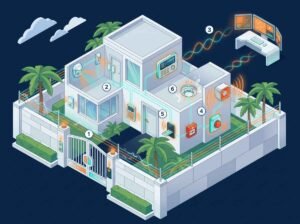
A security solution is not one device doing one job.
It’s a set of functions that need to be covered, each handled by different technology, working toward the same goal, which is stopping something bad from happening, or limiting the damage when it does.
It helps to break this down into six functional layers.
Not every property needs all six, but understanding what each one does makes it much easier to figure out what a given property actually needs.
1. Prevention and Crime Deterrence
This layer is about discouraging trouble before it starts, rather than reacting once it does.
A visible camera, a well-lit compound, a solid perimeter wall or fence, and controlled entry points all signal to a would-be intruder that a property is not an easy target.
For many Nigerian homes, estates and commercial compounds, this starts with the physical perimeter itself:
These are fencing, walls and gates, sometimes reinforced with electric fencing along the top of a wall.
Signal Forte’s services in this layer include perimeter protection and electric fence security, which are typically installed alongside the detection technology described next rather than as a replacement for it.
2. Intrusion Detection
Intrusion detection is the technology that notices when someone has entered a space they shouldn’t have, and raises an alert.
The most common components are door and window contacts (small magnetic sensors that break a circuit when a door or window opens), glass-break detectors (which listen for the specific sound frequency of breaking glass), and motion detectors placed inside rooms or hallways.
Better-quality motion detectors use “dual technology,” combining passive infrared (which senses body heat) with microwave detection (which senses movement through radio waves), and only trigger an alarm when both sensors agree something is moving.
This cuts down on false alarms caused by pets, curtains moving in a breeze, or sunlight shifting across a room.
On larger properties, such as estates or industrial sites, detection can extend to the perimeter itself, using beams or sensors along a fence line rather than waiting for someone to reach a door or window.
Signal Forte’s intrusion detection services include intrusion alarms, glass-break detectors, and indoor and outdoor security sensors.
Because this is one of the four core categories of security solutions, it’s covered in much more depth in Intrusion Detection Systems in Nigeria.
3. System Monitoring and Alerts
Detection is only useful if something happens next.
This layer is the control panel and communication path that takes a signal from a sensor or camera and turns it into an alert someone can act on.
Historically, alarm panels reported over a landline telephone connection.
Most systems now report over the internet, a cellular connection, or both together, since pairing the two means an outage on one path (a cut internet cable, for example) doesn’t leave the property unmonitored, because the other path is still active.
This redundancy matters anywhere internet or power service can be inconsistent, which is a genuine consideration for many Nigerian properties and one we return to later in this guide.
Signal Forte provides 24/7 real-time monitoring of CCTV video, intrusion alarms, fire and smoke detections, and panic alarms, with trained monitoring personnel receiving the alert when a signal comes in.
4. Emergency Response and Verification
Once an alert is confirmed as real rather than a false trigger, this layer covers what happens next.
Audible sirens are often enough on their own to interrupt a burglary in progress, since most intruders are looking to avoid attention, not confront it.
Silent panic buttons serve the opposite purpose..
They let someone call for help without alerting whoever is threatening them, which matters in situations like a robbery or a medical emergency.
The human response behind these devices is just as important as the hardware.
Signal Forte’s stated response process, once an alarm is activated, is for trained monitoring professionals to notify the client, audio-challenge an intruder directly through the system, dispatch security personnel, notify emergency services where required, and record the alarm and the response taken.
Signal Forte states that it maintains a rapid response team capable of being dispatched within minutes of a break-in being detected.
This reflects the company’s stated capability rather than a guaranteed response time, since actual dispatch speed can depend on factors like the property’s location.
5. Access Management and Governance
Where intrusion detection deals with unauthorized entry, access management deals with authorized entry, deciding who is allowed into a space, and when.
Traditional keys are gradually being replaced or supplemented with electronic credentials: PIN codes entered on a keypad, RFID cards or fobs presented at a reader, or biometric verification using a fingerprint or facial scan.
The “governance” part of this layer is about policy: which staff can access which areas, during which hours, and having a record of who went where and when.
This becomes more important as a business or property grows, since a single shared key or code offers no way to tell who actually used it.
Access control is part of Signal Forte’s service offering; the specific credential types available for a given installation are best discussed during a site assessment, since the right choice depends on the property and the level of control needed.
This topic is covered in full in Access Control Systems in Nigeria.
6. Fire and Life Safety
This layer exists to protect people and property from fire, and it works on the same basic logic as intrusion detection: a sensor detects a problem, a panel raises the alarm, and someone responds.
Smoke detectors and heat detectors are the most common initiating devices, sometimes supplemented with manual call points that let a person trigger the alarm directly.
Where sprinklers are the standard suppression method for most buildings, spaces holding sensitive equipment, such as server rooms or data centers, sometimes use gaseous “clean agent” suppression systems instead,
Since these extinguish a fire without the water damage a sprinkler would cause to electronics or documents.
Clean agent systems are defined under the US National Fire Protection Association’s NFPA 2001 standard as non-conductive agents that leave no residue after use..
Whether a Nigerian building needs this level of protection versus standard fire safety measures is a design decision made with a fire safety professional.
Signal Forte’s role in this layer centers on fire alarm monitoring and smoke detection, meaning the sensors, the panel, and the 24/7 monitoring of the signals they generate.
Suppression hardware, such as sprinklers or clean-agent systems, is generally specified and installed as part of a building’s broader fire safety design.
This layer connects closely to Nigeria’s statutory fire compliance requirements, covered later in this guide, and in more depth in Fire Alarm Systems in Nigeria.
Together, these six layers show why a genuinely useful security solution is rarely a single product.
A camera without monitoring only records what already happened.
An alarm without a response plan makes noise but doesn’t stop anyone.
Why Nigerian Homes and Businesses Need Integrated Security
Security spending is easiest to justify when it’s tied to specific, documented risks rather than a general sense that “things happen.”
Four of those risks come up repeatedly for Nigerian homes and businesses, and each one maps onto a different part of the security solution described above.
1. Crime Deterrence and Loss Mitigation
Visible security measures change the decisions criminals make before they act, not just what happens if they do.
A widely cited study of 422 convicted burglars in the United States, conducted by criminal justice researchers at UNC Charlotte, found that “around 60% said the presence of an alarm system would cause them to look for a different target, and a similar share said the same about visible cameras”.
Roughly 83% said they would actively try to find out whether an alarm was present before attempting a break-in at all.
Though the exact figures come from a US-based sample, so they shouldn’t be read as a Nigeria-specific statistic..
But the underlying behavior they describe, that a visible deterrent measurably changes an offender’s target selection, is a reasonable basis for treating intrusion detection and visible cameras as loss-mitigation tools, not just recording devices.
This lines up with the problems Signal Forte’s own customers most often bring to it – unauthorized entry, break-in attempts, theft risk, and the sense that a property is inadequately monitored.
2. Early Fire Hazard Intervention
A fire that starts when a building is empty, overnight in a home, or after hours in an office or warehouse, has no one present to notice it early.
That makes automated detection the difference between a small, contained incident and a total loss.
Nigeria’s Federal Fire Service reported that in 2025, electrical issues such as power surges, overloads and wiring faults caused nearly 70% of all recorded fire incidents nationwide, and private residences alone lost an estimated N14.67 billion in property to fire that year.
Electrical fires are also not confined to occupied hours
A fault in wiring or an overloaded circuit can ignite at any time, which is exactly the scenario a smoke or heat detector connected to 24/7 monitoring is designed to catch, since it doesn’t depend on a person being present to notice smoke or smell burning.
Signal Forte’s fire alarm monitoring and smoke detection services are built around this same logic
Which is detecting the early signs of fire and alerting a monitoring team immediately, rather than relying on someone in the building to notice.
This is covered in far more depth, including Nigeria’s statutory fire compliance requirements, in Fire Alarm Systems in Nigeria.
3. Internal Theft and Access Auditing
Not every security risk comes from outside a property.
The ACFE’s Occupational Fraud 2026: A Report to the Nations, which tracked 397 occupational fraud cases across sub-Saharan Africa, recorded Nigeria as the country with the second-highest number of cases in the region (64), behind South Africa (123), with a median loss of $97,000 per case regionally.
Theft of non-cash assets was one of the most common scheme types identified.
Access control is only one part of addressing this kind of risk, alongside financial controls and internal audit..
But restricting who can enter stockrooms, server rooms, cash offices or other sensitive areas, and keeping a record of who accessed them and when, gives a business a factual trail to investigate against when something goes missing, rather than having to rely on memory or guesswork.
This is one of the practical reasons access control is treated as a core category in its own right rather than an optional add-on.
4. Operational Business Intelligence from CCTV
Once a business has cameras installed for security, the same video feeds can be analyzed for more than just detecting intruders.
AI-enabled video analytics, offered by camera manufacturers across the industry, can count footfall, generate heat maps showing which areas of a store or building get the most traffic, and flag when a queue at a checkout or service point is getting too long.
Retailers use this kind of data to decide where to place high-margin products, when to add staff to a till, or which parts of a store layout aren’t working.
Signal Forte’s AI-enabled CCTV analytics include heat mapping and queue detection, alongside other analytics capabilities, meaning a system installed primarily for security purposes doesn’t have to be a purely defensive cost.
A retailer or hotel operator using Signal Forte’s CCTV analytics can see which areas of a store or lobby draw the most foot traffic, spot when a queue at a till or reception desk is building up, and use that information for decisions like staff placement or layout changes, on top of the security function the same cameras already provide.
Together, these four risks, criminal, fire, internal, and purely operational, explain why a property’s security needs rarely stop at only “installing a camera.”
Main Types of Security Solutions (4 Core Pillars)
Most people researching security solutions in Nigeria are really shopping for one or more of four things
Which are ways to detect intrusion, a way to see what’s happening on a property, a way to detect and respond to fire, and a way to control who gets in.
Each is substantial enough to deserve its own dedicated guide, so this section explains what each one is and how it works, without trying to replace that deeper coverage.
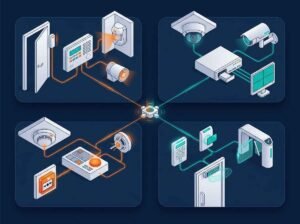
1. Intrusion Detection and Burglar Alarm Systems
An intrusion detection system exists to notice unauthorized entry and raise an alarm.
At the center of it sits a control panel, the system’s “brain,” wired or connected wirelessly to a set of sensors: magnetic contacts on doors and windows, glass-break detectors, and motion sensors placed to cover rooms, hallways or entry points.
On larger sites, such as estates or industrial compounds, detection can extend outward to the perimeter itself using beams or fence-mounted sensors, catching an intrusion before someone reaches a building.
Two design choices matter most when specifying a system:
| Choice | Option A | Option B |
|---|---|---|
| Wiring | Wired: sensors connected by cable to the panel. More resistant to interference, but a cut cable can disable the circuit it’s on, and installation is more labor-intensive. | Wireless: sensors communicate by radio signal. Easier and less disruptive to install, particularly in existing buildings, but relies on batteries and can be affected by radio interference from other devices. |
| Monitoring | Self-monitored: alerts go to the property owner’s phone, and it’s up to them to decide whether to call for help. Lower ongoing cost, but depends entirely on the owner noticing and acting on the alert. | Professionally monitored: alerts go to a monitoring team who can verify the alarm and take action, day or night, whether or not the owner is reachable. |
Signal Forte’s intrusion detection services include intrusion alarms, glass-break detectors, and indoor and outdoor security sensors, backed by 24/7 professional monitoring rather than a self-monitored setup.
An audible siren is often included alongside monitoring, since an alarm that makes noise on-site can interrupt a break-in even before a monitoring team or the property owner responds.
2. Video Surveillance (CCTV) Systems and AI Analytics
Video surveillance systems record and, increasingly, actively analyze what’s happening on a property.
Cameras come in several common physical formats, each suited to different situations:
- Dome cameras: discreet, ceiling-mounted, and hard to tell which direction they’re pointed, which suits indoor spaces like offices, retail floors or hotel corridors.
- Bullet cameras: cylindrical and clearly visible, making them a deterrent in their own right; commonly used on perimeters, entrances and parking areas.
- Turret (eyeball) cameras: similar to domes but without an outer glass cover, giving better night image quality, often used in corridors and smaller retail spaces.
- PTZ (pan-tilt-zoom) cameras: can be remotely rotated and zoomed to follow activity across a large area, useful in warehouses, large compounds or anywhere a single camera needs to cover ground that would otherwise need several fixed ones.
- Fisheye cameras: an ultra-wide, 360-degree lens that covers an entire room or hall from one mounting point, useful in banks, large retail floors or reception areas.
- Thermal cameras: detect heat rather than visible light, useful for perimeter monitoring in total darkness, fog or smoke, though these are typically reserved for higher-risk industrial or perimeter applications rather than general indoor use.
Behind the cameras, most modern systems run on IP (internet protocol) technology, meaning each camera connects to a network rather than to a dedicated recorder by a separate cable.
Power over Ethernet (PoE) lets a single cable carry both data and power to the camera, simplifying installation.
Footage is stored on a Network Video Recorder (NVR), often with cloud backup as well, so recordings survive if something happens to the physical device on-site.
AI-enabled analytics add a further layer on top of the raw footage, drawing virtual “tripwires” that trigger an alert when crossed, or distinguishing between a person and a vehicle so the system doesn’t raise an alarm for every passing car.
Signal Forte’s video surveillance services cover CCTV installation, video monitoring, video review and analysis, and AI-enabled CCTV analytics, specifically heat mapping and queue detection, which extend the same cameras into operational tools as described earlier in this guide.
Exact camera types and system architecture for a given property are typically decided during a site assessment rather than fixed in advance, since the right mix depends on the layout, lighting and risk profile of the site.
This category is covered in full in Video Surveillance Systems in Nigeria.
3. Fire Alarm and Life Safety Systems
A fire alarm system exists to detect the early signs of fire and alert people before it spreads.
Detection typically comes from smoke detectors, heat detectors, or occasionally flame detectors for specific industrial risks, along with manual call points that let a person trigger the alarm directly.
Once triggered, notification devices, usually sounders and, in some buildings, visual strobes, alert occupants to evacuate.
Fire alarm panels come in two main architectures:
- Conventional panels divide a building into wired zones. If a device in a zone triggers, the panel identifies the zone but not the specific device, meaning someone still has to search that area to find the actual source. This is generally more affordable and suits smaller, simpler buildings.
- Addressable panels give every device its own unique identifier, so the panel can pinpoint the exact detector or call point that triggered, which matters in larger or more complex buildings where “somewhere in this wing” isn’t precise enough for a fast response.
It’s worth separating fire detection from fire suppression.
Detection, the smoke and heat sensors described here, identifies that a fire exists and raises the alarm.
Suppression, whether a standard sprinkler system or the gaseous “clean agent” systems mentioned earlier in this guide for sensitive spaces, is what actively puts the fire out or slows it down.
A building typically needs both, designed and specified as part of its overall fire safety plan.
Signal Forte’s role in this category centers on fire alarm monitoring and smoke detection
The detection devices and the 24/7 monitoring of the signals they generate. This connects directly to Nigeria’s statutory fire compliance requirements.
4. Access Control and Identity Management Systems
Access control governs who can enter a space, replacing or supplementing a physical key with an electronic credential.
Common credential types include PIN codes entered on a keypad, RFID cards or fobs presented at a reader, smartphone-based credentials using Bluetooth, and biometric verification such as a fingerprint or facial scan.
Each has different trade-offs: a PIN can be shared or forgotten, a card can be lost or lent to someone else, while biometric methods tie access to a specific person but require the hardware and, in some settings, raise privacy questions worth discussing upfront.
Beyond individual credentials, larger sites use physical barriers to enforce access decisions: turnstiles and speed gates at entrances, electromagnetic locks on doors, and in higher-security environments, a “mantrap,” an interlocking two-door enclosure that only allows one verified person through at a time.
The organizing principle behind all of this is often role-based access control (RBAC): rather than granting or removing permissions for each person individually, access rights are tied to a role (for example, “warehouse staff” or “finance department”),
So moving someone into or out of a role automatically updates what they can access, and the system can show a log of who entered where and when.
Access control is part of Signal Forte’s service offering.
As noted earlier in this guide, the specific credential types and barrier hardware suited to a property are matched during a site assessment rather than fixed in advance.
How the Four Pillars Compare
| Security function | What it detects/controls | Common components | Typical applications | Works with other systems by |
|---|---|---|---|---|
| Intrusion Detection | Unauthorized entry into a space or across a perimeter | Control panel, door/window contacts, motion sensors, glass-break detectors, sirens | Homes, offices, warehouses, estates | Triggering cameras to record the alert location and notifying a monitoring team |
| Video Surveillance | Visual activity across a property, indoors or outdoors | Cameras (dome, bullet, PTZ, etc.), NVR, AI analytics | Retail, offices, estates, industrial sites, hospitality | Providing visual verification for intrusion and access events; supplying footage for review after an incident |
| Fire Alarm Systems | Smoke, heat or flame indicating a fire | Smoke/heat detectors, manual call points, control panel, sounders/strobes | All occupied buildings; statutory requirement in many commercial settings | Triggering evacuation notifications and, in integrated systems, unlocking access-controlled exits automatically |
| Access Control | Who is authorized to enter a space, and when | Credential readers, electromagnetic locks, turnstiles, access control panel | Offices, warehouses, schools, restricted industrial areas | Logging entry alongside camera footage for a complete record of who accessed a space and when |
Seen this way, the four pillars aren’t competing purchases, they’re different functions that, on their own, each leave a gap the others fill.
Nigerian Legal Framework and Regulatory Compliance
Two areas of Nigerian regulation matter for security planning even when the security itself is electronic rather than a guard on the gate.
The rules governing private guard companies, and statutory fire safety requirements that apply to occupied buildings generally.
Private Guard Companies and NSCDC Regulation
The Nigeria Security and Civil Defence Corps (NSCDC) is the statutory body responsible for registering, licensing, training and supervising private guard companies (PGCs) in Nigeria, under the Private Guard Companies Act.
This applies to companies that supply and deploy security guards, which is a different business from electronic security installation and monitoring..
Signal Forte’s services described in this guide, CCTV, alarms, fire and smoke detection, monitoring and access control, are electronic rather than guard-supply services.
If a property also engages a separate company to provide physical, on-site guards, the information below applies to that company.
To register as a PGC, a company needs, among other requirements, a minimum authorized share capital of ₦10,000,000, at least three directors, and one of those directors must be a retired military or paramilitary officer, from the rank of Major or Commissioner respectively.
Licensed PGCs fall into one of two categories: Category A licenses permit a company to employ 500 or more guards, while Category B covers companies employing fewer than 500.
Registration also involves a formal application to the NSCDC’s Commandant General, along with fees, background checks on directors, and a proposed training program and salary structure for guards.
Also one point worth stating plainly is private security guards in Nigeria are not permitted to carry firearms.
The NSCDC’s own leadership has repeated this directly to newly licensed companies, cautioning them against firearms, sirens, and other equipment prohibited under the PGC Act.
For a business hiring a guard company, the practical takeaway is to confirm that the company holds a current, renewed NSCDC license before engaging them, rather than assuming a license obtained years ago is still valid.
The NSCDC has sealed and de-registered guard companies for operating with expired or no licenses, and has separately arrested guards found working for unlicensed or unregistered outfits.
It’s worth noting, however, that a 2020 Federal High Court ruling (in a case brought by Reiz Continental Hotel against the NSCDC and the Minister of Interior) held that a business employing its own security staff directly, rather than contracting a PGC, is not legally compelled to register as one.
This is a legal nuance rather than a blanket exemption, and a business with an in-house or hybrid guarding arrangement should get specific legal advice on its own situation rather than relying on a general summary.
Statutory Fire Safety Compliance
Nigeria’s National Fire Safety Code, first published in 2013 by the Federal Fire Service, sets out minimum standards for fire prevention, detection, suppression and emergency response, covering building design and construction, electrical installation, fire detection and alarm systems, suppression equipment, and evacuation planning.
This is a national baseline, but it isn’t the only layer of regulation a property may need to satisfy.
Several states operate their own fire services with their own legal frameworks, for example, the Lagos State Fire and Rescue Service, which enforces fire safety in Lagos separately from the Federal Fire Service, and Ekiti State’s Fire Service, which has its own certificate registration process under state law.
This means the exact documentation, process and fees for fire safety certification can differ depending on where a property is located, and should be confirmed directly with the relevant state fire service or the Federal Fire Service rather than assumed to be uniform nationwide.
In general, fire compliance for a commercial building involves preparing documentation about the building and its fire safety measures, submitting an application to the relevant fire authority, and going through a site inspection that checks things like alarm panels, smoke detectors, emergency lighting, clear exit routes, and evidence that fire extinguishers have been serviced
Enforcement is a real, ongoing activity rather than a formality..
The Federal Fire Service’s leadership has stated publicly that non-compliant structures will be sanctioned, and the service has fined businesses, including filling stations, for failing to meet the safety code.
Signal Forte’s role in this picture, as described earlier in this guide is the fire alarm monitoring and smoke detection.
The detection hardware and the 24/7 monitoring of the signals it generates.
Full statutory fire compliance for a building, covering structural fire safety, suppression systems, extinguisher servicing and the certification process itself, typically involves coordination with a qualified fire safety consultant and the relevant fire authority alongside the electronic detection and monitoring side.
Understanding this regulatory backdrop matters when comparing options, which is where residential and commercial security needs start to diverge in practice, covered next.
Residential vs. Commercial Security Requirements
Residential and commercial properties both draw on the same four pillars covered earlier, but what gets prioritized, and how much of it is needed, differs quite a bit.

Residential Security — Homes, Apartments and Gated Estates
For a standalone home or apartment, the priority is usually straightforward..
Protect the entry points, keep the family informed of what’s happening even when they’re not physically present, and make sure a real incident gets a real response.
This typically means intrusion detection on doors and windows, cameras covering entrances and the compound rather than every room, and alerts that reach a smartphone rather than only sounding a siren on-site.
Signal Forte’s remote and real-time monitoring is built around this need, giving a homeowner visibility into their property and a monitoring team watching the same signals, rather than relying solely on being home to notice something is wrong.
Gated estates are a distinct category worth addressing on their own, since they’re such a common residential model in Nigerian cities.
It’s worth being clear-eyed that “gated” covers a wide range in practice..
At one end is a genuinely managed estate with a permanently staffed checkpoint, enclosed perimeter walls, and professional oversight of shared security; at the other is a single entrance gate that may or may not be staffed consistently.
Confirming which of these describes a specific estate matters more than the label itself.
Where an estate is professionally managed, the visitor experience is increasingly digital rather than a paper logbook at the gatehouse
Residents can pre-approve visitors through a mobile app, a QR code or similar credential is scanned at the gate instead of a phone call to confirm, and the resident gets a notification when their visitor arrives.
Nigerian estate-management platforms offering exactly this kind of app-based visitor booking are already active in the market,
Which reflects a genuine shift away from manual visitor logs rather than a hypothetical future.
Vehicle recognition cameras (the LPR/ANPR technology described earlier in this guide) extend the same idea to cars, flagging vehicles that aren’t on an approved list.
Estates considering this kind of setup should treat camera and access control hardware, and how it needs to work with any estate management software already in use, as something to plan during a site assessment rather than assume it will simply connect.
Commercial Security — Offices, Retail, Warehouses, Schools and Hotels
Commercial security has to account for more people, more locations in some cases, and consequences that go beyond the property itself.
A few considerations become more important at commercial scale than they typically are for a single home:
Employee access governance matters more where there are shift workers, contractors, and staff turnover to manage.
The role-based access control described earlier, tying access rights to a role rather than an individual, becomes genuinely useful once there are more than a handful of people needing different levels of access to different areas.
Business continuity is a real, if easy to underestimate, cost of a security incident
A break-in, a fire, or even an extended period of disruption doesn’t just cost whatever was stolen or damaged..
It can also mean lost trading hours, delayed reopening, and the operational cost of getting back to normal.
This matters more for Nigerian SMEs specifically, since many operate with thin cash reserves and limited capacity to absorb an unexpected shock, a point Nigerian business consultancies have been making in the context of the country’s broader operating environment.
Statutory compliance tends to fall more heavily on commercial and public buildings than on a single-family home, particularly the fire safety obligations covered earlier in this guide.
Beyond these general points, priorities shift again by industry.
Signal Forte serves offices, retail, education, energy, and oil and gas properties, and each tends to weight the four pillars differently
Schools generally prioritize controlled visitor access and knowing exactly who is on-site; hotels need security that doesn’t undermine a welcoming guest experience,
Which usually favors more discreet camera placement (the dome and turret cameras described earlier) over highly visible hardware.
Retail businesses combine loss prevention with the CCTV analytics and larger sites like warehouses or industrial facilities typically need wider camera coverage per unit,.
Which is where the PTZ and thermal camera options described earlier become more relevant than they would be for a small office.
Understanding these differences sets up the practical question most readers actually came here to answer: what does my specific property need, and how do I decide?
Security System Installation and Preventative Maintenance
A security system is only as good as its installation and its upkeep.
Good hardware, badly installed or left unmaintained, underperforms in ways that only become obvious during an actual incident, exactly when it matters most.
Professional Installation vs. DIY
A basic, single-camera setup in a small space is reasonable to install without professional help.
Anything more complex, a full property, a business, or a system combining several of the four pillars, benefits from professional installation for reasons that aren’t always obvious until something goes wron
Signal Forte’s installation services are handled by trained professionals who manage the installation, setup and integration of the security components involved, rather than leaving these judgment calls to guesswork.
Signal Forte offers system health checks, offered as a value-added service alongside installation and monitoring.
This kind of ongoing check helps keep systems operational, improves their accuracy, and extends their working life,
Which is consistent with why preventative maintenance is treated as standard practice across the security industry rather than an optional extra.
Installation and maintenance are two of the ongoing costs of a security system, alongside the upfront cost of the equipment itself.
How Much Do Security Systems Cost in Nigeria? (Budgeting Guide)
There’s no single honest answer to “how much does a security system cost in Nigeria,” because the same question covers a single-camera home setup and a multi-building industrial site.
What’s more useful is understanding what actually drives the cost, so a quote makes sense once you have one.
What Actually Drives the Cost
- Property size and layout:
More entry points, more square footage, and multiple floors all mean more cameras, sensors or access points, and more cabling
- Hardware quality and origin:
Most security equipment sold in Nigeria is imported, which means naira movements against foreign currencies affect equipment pricing more directly than they affect local labor costs.
This is one reason two quotes taken months apart can differ even for an identical system.
- Power redundancy:
An inverter, UPS or solar backup adds to the upfront cost but is often necessary given the reliability of Nigeria’s public power supply.
- Monitoring plan:
Self-monitored systems have lower ongoing costs than professionally monitored ones, which typically carry a monthly or annual monitoring fee in exchange for 24/7 response.
- Installation complexity.
Older buildings, difficult cable runs, or multi-story properties take more labor time than a straightforward single-floor installation.
- Ongoing maintenance.
The Annual Maintenance Contract is usually a separate, recurring cost from the initial installation, not a one-time fee.
- Compliance costs where applicable.
Fire safety certification, carries its own fees that vary by state and building type, separate from the electronic security system itself.
What This Looks Like in the Current Nigerian Market
The following are examples from other providers’ public pricing and market research, not Signal Forte’s pricing, included only to show the kind of range property owners in Nigeria are currently encountering.
They will shift with the exchange rate and with each provider’s own costs, so treat them as a snapshot rather than a budget you can rely on directly:
| System | Illustrative range seen in the market |
| Basic CCTV (4–8 cameras, phone viewing) | Roughly ₦150,000–₦230,000 |
| Home intrusion detection and alarm system, full installation | Around ₦495,000 |
| Bundled property security upgrade (smart lock/access control, gated intercom, on-site guard) | Roughly ₦2,000,000–₦5,500,000 |
These three aren’t directly comparable, they cover different combinations of equipment and, in the last case, an ongoing guard salary rather than only hardware,
But together they give a rough sense of how widely pricing spans depending on what’s actually included.
Getting a Tailored Quote
Because the same “CCTV system” or “alarm system” can cost very different amounts depending on the specific property,
The most reliable way to budget is the site assessment which turns a property’s actual layout and requirements into a real quote rather than a generic estimate.
If you’d like a quote based on your own property, you can book a consultation with Signal Forte Systems Limited by calling or messaging 08100374713 on WhatsApp.
Common Security Mistakes to Avoid in Nigeria
Most of these mistakes aren’t exotic, they’re the practical consequences of skipping a step this guide has already covered, or overlooking something specific to Nigeria’s climate and power supply.
1. Buying hardware before assessing the property.
Choosing cameras or sensors first and figuring out placement later tends to produce coverage gaps and false alarms.
The site assessment described earlier in this guide exists specifically to prevent this, working out entry points, blind spots and asset locations before any equipment is chosen.
2. Treating CCTV as the whole system.
Cameras record what happened; they don’t stop it from happening or actively alert anyone in real time the way intrusion detection and access control do.
As covered in the section on the four core pillars, cameras work best paired with active detection, not as a replacement for it.
3. Overlooking power protection, and confusing it with power backup.
These are two different problems.
Backup power, an inverter, UPS or solar setup, keeps a system running during an outage, as covered earlier.
Surge and voltage protection is a separate concern.
A Nigerian power-equipment specialist quoted in BusinessDay identifies three distinct power conditions, sudden voltage surges that cause instant damage, ongoing voltage instability that shortens equipment lifespan over time, and total blackouts, each requiring a different solution, a surge protector, an automatic voltage regulator (AVR), and a UPS, respectively.
A system protected against outages but not against surges can still suffer damaged cameras, recorders or panels from a voltage spike, often when power is restored after a cut.
4. Letting fire safety become an afterthought.
This includes skipping smoke detection entirely on the assumption that a property is low-risk, and letting fire extinguisher servicing lapse, which was covered as part of Nigeria’s statutory fire compliance requirements earlier in this guide.
An extinguisher past its service date, or a smoke detector nobody has tested, provides a false sense of security rather than real protection.
5. Not planning for Harmattan dust.
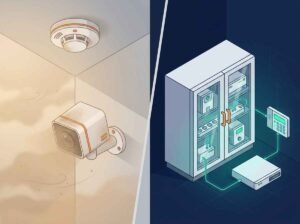
Nigeria’s dry-season Harmattan wind, tracked by the Nigerian Meteorological Agency (NiMet), blows fine Saharan dust across much of the country roughly between late November and March, reducing visibility and coating exposed surfaces, camera lenses included, with a fine dust layer that can noticeably degrade image clarity if left unaddressed.
This matters for optical smoke detectors too, which work by detecting how smoke particles scatter light..
Heavy ambient dust can interfere with that same mechanism, either triggering false alarms or, over time, requiring more frequent cleaning to keep readings accurate.
This is one of the more overlooked reasons the preventative maintenance schedule matters more in Nigeria during Harmattan months than it might in a less dusty climate.
6. Engaging a guard company without checking its NSCDC status.
Private guard companies must hold a current, renewed NSCDC license, and the NSCDC has sealed companies operating without one.
Asking to see this before signing a contract is a reasonable, low-effort check.
These mistakes are largely avoidable with the planning steps already covered in this guide.
The remaining question is what to look for when evaluating a security provider itself, covered next.
The Security Solutions in Nigeria – FAQs
What is the difference between an intrusion detection system and a CCTV camera system?
Intrusion detection systems use sensors like door contacts, motion detectors and glass-break detectors to notice unauthorized entry and raise an alarm.
CCTV systems record and let you see what’s happening, but don’t inherently alert anyone unless paired with monitoring or analytics.
They solve different problems and are typically used together, as covered in the section on the four core pillars above.
What happens to my security system during a power outage in Nigeria?
It depends on whether backup power was planned for.
A system with an inverter, UPS or solar backup, and an alarm panel that can report over a cellular connection as well as the internet, should keep functioning through most outages.
A system without this kind of backup can go offline during a cut, as covered in the sections on infrastructure readiness and common mistakes above.
What is the difference between conventional and addressable fire alarm systems?
A conventional panel identifies which wired zone triggered an alarm but not the specific device, so someone still has to search that area.
An addressable panel gives every device its own identifier, pinpointing the exact detector that triggered, which matters more in larger or more complex buildings.
How does biometric access control improve security over physical keys or swipe cards?
A key or card can be lost, copied, or lent to someone else without anyone knowing.
A biometric credential, a fingerprint or facial scan, ties access to the specific person, which is why it’s often used where accountability matters more, though it comes with its own hardware cost and, in some settings, privacy considerations worth discussing upfront.
Can security cameras function and record without an active internet connection?
Yes, generally.
Footage is typically stored locally on a Network Video Recorder (NVR), which doesn’t require the internet to keep recording.
Internet connectivity mainly matters for remote viewing, cloud backup, and certain monitoring alerts, which is why the redundancy (internet plus cellular backup) matters for the monitoring side specifically, not for basic recording.
How often should security cameras and fire alarm systems be serviced in Nigeria?
There’s no single legally mandated interval confirmed for Nigeria specifically, so this comes down to general good practice..
Camera lenses typically benefit from cleaning every one to three months, more often during Harmattan, while a fuller system health check or AMC visit is commonly done quarterly to annually.
Fire alarm systems are generally tested at least annually as standard practice
For a specific building, it’s worth confirming any required interval with the relevant fire authority or a qualified fire safety professional.
Choosing the Right Security Company in Nigeria
Everything covered in this guide, the technology, the regulations, the Nigerian-specific considerations, ultimately feeds into one practical decision
Which company actually installs and supports the system?
A few questions are worth asking of any vendor being considered.
What to Look for in a Security Vendor
Relevant, specific experience.
Ask how long the company has been designing and installing electronic security systems, not just reselling hardware.
Experience with the pillars relevant to the property in question (fire alarm work for a commercial building, for instance) matters more than years in business generally.
A proper site assessment before a quote.
As covered earlier in this guide, a vendor willing to quote a fixed package without visiting or assessing the property is a warning sign, since the quote isn’t actually based on what the property needs.
Traceable, genuine hardware.
Nigeria’s market includes both authorized distributors and lower-quality imports.
A vendor should be able to explain where their equipment comes from and answer questions about it directly, rather than being vague about sourcing.
A realistic power and connectivity plan.
Given the grid reliability considerations, ask specifically how a vendor plans for outages and for connectivity redundancy, rather than treating backup power as an afterthought.
Awareness of statutory context.
A vendor operating in this space should understand the regulatory landscape covered earlier, NSCDC requirements if physical guards are involved, and general fire safety compliance obligations, even where actual certification is handled by the relevant government authority rather than the security vendor itself.
Clear ongoing support.
Ask whether maintenance is a built-in, scheduled service or something arranged separately later, and what monitoring options are actually offered.
About Signal Forte Systems Limited
Signal Forte Systems Limited is a Nigerian security and ICT company based in Port Harcourt, Rivers State, also serving clients in other Nigerian cities.
Its team draws on a combined experience of more than 21 years across the security and ICT sectors, including more than 17 years specifically on electronic security projects, design, installation, integration and monitoring.
Signal Forte’s services cover all four pillars discussed throughout this guide which are.. Intrusion detection alarms and monitoring, CCTV and video surveillance, Fire alarm monitoring and smoke detection, panic alarm monitoring, access control, and perimeter protection including electric fencing, etc.
These are backed by 24/7 real-time monitoring covering CCTV, intrusion alarms, fire and smoke alarms, and panic alerts through a single monitoring operation, along with system health checks aimed at keeping installed systems operational and extending their working life.
Registered in Nigeria under RC1395958, Signal Forte serves residential homes, commercial offices, businesses, educational institutions, retail, energy, and oil and gas properties across the areas it operates in.
Ready to Move Forward?
If you’d like a plan built around your own property rather than a generic package, Signal Forte offers on-site assessments and tailored proposals for homes and businesses.
You can reach Signal Forte by phone or WhatsApp at 08100374713, or through signalforte.ng
